
The Sixty Minute Practice Session - Quick Link
Lessons 1 - 10 Beginners
The most important part of beginning piano is getting acquainted with the piano. By lesson #10, a student should be able to:
Lessons 1 - 10 Older Beginners and Adult Learners
The most important part of beginning piano is getting acquainted with the piano.
We will do this through some experimentation and begin to develop our ears.
The more you listen to piano music, the more your ear will learn to recognize the various octaves (lower, middle, higher), and you’ll begin to hear the unique characteristics of major and minor modes, the various scales, and begin to recognize “intervals”
Adult learners will begin to read notation within the first three lessons. Understanding notation takes time and practice. Shad will supply older students with exercises and short pieces to help facilitate the process.
Students who simply need a refresher will be given a developmentally appropriate set of pieces to ease you back into the process of reading musical notation on the “grand staff”.
What will lesson 40 look like, given where we are at in Lesson 11?
By lesson 11, I will be able to assess how independent our practicing can be. Are we ready to proceed beyond a 15 minute practice session? How attentive is our attention span? To what extent do I need to shift attention to developing an attention span that exceeds the 2 minute pace? Can I layer elements of music - or are we going to continue to focus on the one at a time exploration of how to make sense of the keys in front of us?
What will our pathway look like by Age 7-8? Will be enter District Auditions? Should we begin the sequence of ABRSM levels and skill development?
Progress and Assessment Standards are measured for aptitude, as well as basic progress.
·Steady Beat (i.e. the importance of duets!)
·Note reading – Entire Treble and Bass Staff – 4 octaves
·Rhythm – Eighth, Quarter, Half, Dotted Half, Whole & corresponding rests; 34 and 44 time signatures. 68 time signatures when appropriate.
By the end of the fourth year of piano study, I would ideally introduce each student to:
An intermediate piano student might be able to play two contrasting movements of a classical Sonatina by Clementi, Beethoven, or Haydn.
Lesson 1 - 2 - 3
Identify the Lowest A on the Piano
Identify the Highest C on the Piano
Find Middle C
Play at least 1 or 2 pieces by “rote” with minimal prompting.
Lesson 4 - 5 - 6
I almost never teach these the same way to two different students.
My goal with lessons 4-6 is to learn about the student. How do you think? What are your dominant ways of knowing? Are you deeply entrenched in those ways of knowing, or are you adaptable? Does piano truly interest you, or is this less an exercise in passion and a love for music (that’s fine if it’s not, but I like to identify this condition in the early stages of lessons)? If piano doesn’t truly interest you, maybe another instrument and/or singing does? Maybe you are deeply rhythmic? All of this is important information for me to understand as I think about how to develop your lessons past the formative 10 lessons.
At lesson 7 or 8, I will know the best way to introduce a student to the concept of a LINE and a SPACE note. This is the foundation of musical notation. By lesson 8, some students will begin to read notation on the staff - other students need to live in the “rote” stage a little longer.
Younger students, and very creative individuals will benefit from more experiences before we dive too deeply into notation.
We’re unique humans, and our learning styles vary - so to should the lesson.
Here’s where Mr. Shad’s experience and passion for teaching kicks into full gear!
Rhythm
Is it the timing of events on a human scale?
Is it how we mark the passage of time?
Rhythm can be defined - and that is what we do by naming quarter, half, whole notes & rests - etc.
Rhythm engages strong and weak beats.
Duple and triple forms of meter based upon those strong and weak beats.
Rhythm is cycles and patterns both observed, created, defined, and cycled.
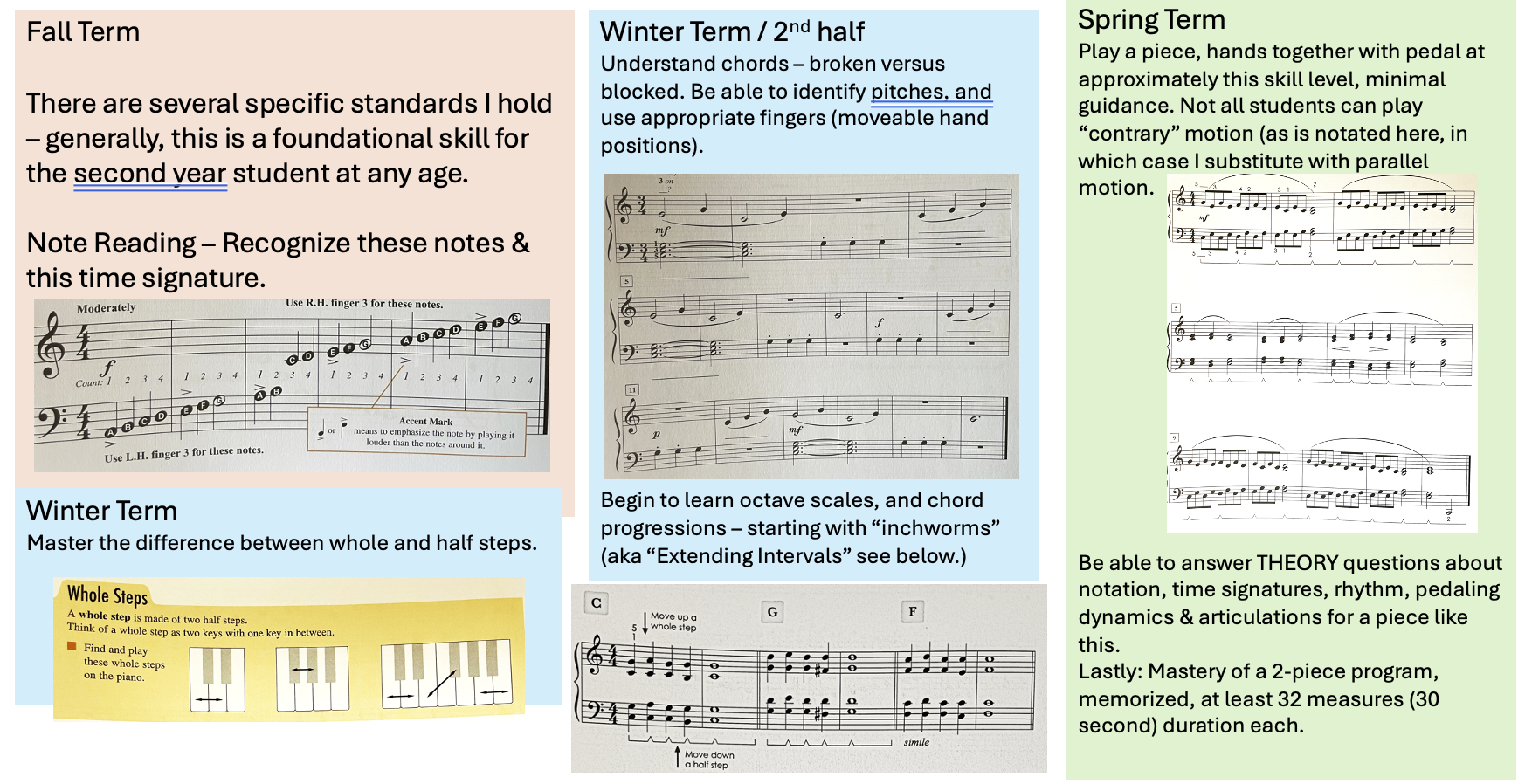
A basic baroque era piece (Musette) or a similar piece that requires both hands work together. For advancing and motivated student, this might mean studying our first Bach Invention.
A fourth year student should be able to distinguish between a 2nd and a 3rd by ear; major and minor by ear; listen to and recognize by ear the difference between an AB and ABA pattern (Binary, Ternary).
A fourth year student might have a Sonatina memorized and ready to perform for an audition.
An intermediate piano student might develop a strong sense of musical intuition. Lessons become increasingly independent - students can begin to make decisions. I may ask questions - does this fingering feel more natural than that fingering? Does this marked diminuendo make sense here, or do you think the music needs to stretch or contract differently?
What is rote playing?
Simply stated - it is imitation. There’s more to it - but the idea is this is a non-notation approach to playing, one that requires the teacher to present material that can be observed and imitated by the student.
A cautionary tale:
I try not to “over-teach”.
Many piano method books “over teach”. They assert a particular pathway that is somehow developmental or sequential without recognizing that
a) true learning is almost never logically sequential,
and
b) many students have a kind of intuition with music based upon their prior experiences.
As a music teacher, I want to unlock that experience and learn to harness that into teaching the student (first) - getting YOU inspired and motivated - then teaching music (second) -
giving you an appreciation for music as a sense and an experience -
and then teaching the piano (…third, but fundamentally what we’re doing here in my studio!).
Term 2 at the Piano with Mr. Shad
By lesson 11, I am thinking about where we can be by year 2 at piano. Will it mean we’ve taken a particular method book as a pathway? Does it mean we’re going to continue to enjoy mostly rote learning, peppered with some elements of music?
Melody
Melodies are linear. They are what we can sing or speak.
Melody is the song itself.
It is defined by steps - half and whole - and intervals.
Patterns of these form scales and kinds of patterned elements that can be coupled with rhythm to form musical ideas.
Harmony
Harmonies are often notated as the vertical elements of music. They are what we sense as being simultaneous,
Harmony is concerned with that which is combined, defined by tension and release, pleasant and discordant, chords and their progressions woven together to create a fabric of that which we call music.
Often defined as an antecedent to Melody - but I disagree - melody and harmony are intertwined and co-exist.
2nd Year at the Piano: Ages 6 1/2+
There is still no “typical” student. Whether or not you are somehow defined as neurotypical or divergent, I am aware of individuals’ strengths and weaknesses. Neuro-definition is a useful way to think about to what extent learning can be independent and at what point practice need no longer be supervised - but it is not useful to the attentive piano teacher.
Third and Fourth Year
Intermediate Piano
Practice Standards for All Students
-All students must practice at least 4 times between each lesson. If you need to make an exception, please let Shad know in advance.
-Practice at least once within the 24 hours following your lesson. Open the notebook first.
-Posture. Sit properly.
-Back Straight
-Use a footstool for younger students
-Arms and hand relaxed from shoulder
-Elbows slightly higher than keys
-Sit on the front half of the bench
-Feet flat
A motivated 4th year student should be able to memorized a 3 piece program for District Auditions (D3) and/or ABRSM Level 1 or 2.
A motivated 4th year student should be able to play half a dozen keys in the I IV I V7 I I I chord progression, and each corresponding one octave scale with both hands together, at a slow and steady pace.
An intermediate piano student should be able to take an instruction such as - create a 30 second improvisation that you can play 2 times in a row, nearly identically both times.
From there, we may begin to notate the melodic and harmonic structures - eventually leading to a more sophisticated awareness of rhythmic notation as well.